
Smarter Cooling Begins with Smarter Compressor Control
COOLNOMIX adds an intelligent control layer to compatible cooling equipment. By monitoring relevant air temperatures and working with the existing control system, it helps manage compressor operation to reduce avoidable electricity consumption.
We are not trying to deliver less cooling. We are working to deliver the cooling your facility needs with less unnecessary energy use.
COOLNOMIX works with the existing thermostat and controls — not against them — to manage compressor operation and reduce avoidable electricity consumption.
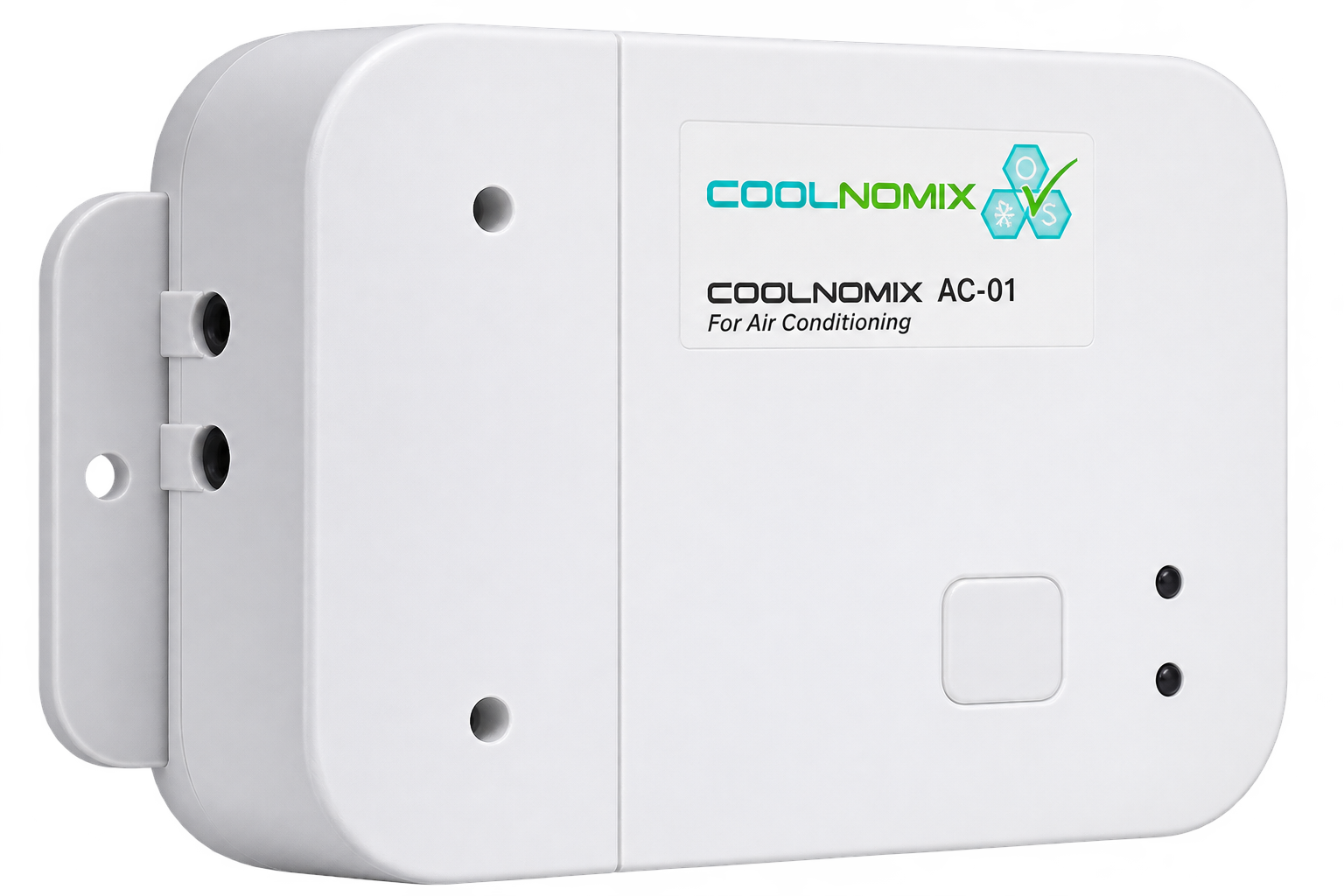
COOLNOMIX AC-01 unit with patented ORS technology

An Air Conditioner Does Not Create Cold. It Moves Heat.
A conventional direct-expansion air conditioner removes heat from indoors and rejects it outdoors. Understanding this cycle is the foundation for understanding where electricity is consumed — and where COOLNOMIX can help.
Evaporator
Indoor air passes over the evaporator coil. Refrigerant absorbs heat from the air, allowing cooler air to return to the occupied space.
Compressor
The compressor raises the refrigerant vapor's pressure and temperature, allowing heat to be rejected outdoors. It is a major electricity-consuming component of many conventional cooling systems.
Condenser
The refrigerant releases heat to the outdoor environment and condenses into liquid.
Expansion Device
The refrigerant passes through an expansion device, reducing its pressure before returning to the evaporator. The cycle repeats as cooling is required.
The Direct-Expansion Refrigeration Cycle
Conceptual IllustrationConceptual illustration of the direct-expansion refrigeration cycle. Not an installation or wiring instruction. Refrigerant flow is shown; control wiring is intentionally omitted. Final configuration requires current manufacturer-approved documentation and qualified personnel.
Executive takeaway
If a cooling system can meet its temperature requirements with less unnecessary compressor operation, it may consume less electricity.
Temperature Control and Energy Optimization Are Related — but Different.
A thermostat monitors temperature and communicates when cooling is required. It is essential to the operation of the air-conditioning system. However, the thermostat does not necessarily describe every relevant condition within the refrigeration cycle.
The Thermostat's Role
The thermostat maintains the space temperature setpoint. It decides when cooling is needed and when the compressor can stop based on the temperature it senses.
COOLNOMIX's Supplemental Role
COOLNOMIX adds operating information — return-air and supply-air temperature behavior — that can help compatible equipment manage compressor runtime more efficiently. It works with the existing thermostat and cooling controls rather than replacing their fundamental purpose.
Key message
We work with the existing thermostat and cooling controls rather than replacing their fundamental purpose.
Two Temperature Sensors Help Tell a More Complete Story.
In the normal sensing arrangement, COOLNOMIX uses two temperature sensors to evaluate the cooling system's operating condition.
Return-air temperature
This represents the temperature of air returning from the cooled space. It helps indicate whether the space is meeting its required temperature conditions.
Cold supply-air temperature
This represents the temperature of air leaving the cooling coil and being supplied to the space. Its behavior provides information about the cooling system's operating condition.
COOLNOMIX evaluates these temperature inputs through its embedded control logic. Accurate sensor placement matters — sensors should measure representative airflow rather than be influenced by adjacent metal surfaces or unrepresentative equipment compartments.
Management takeaway
Good control decisions depend on good measurements.
Normal Arrangement
Conceptual IllustrationNormal arrangement: one sensor reads return-air temperature, one reads cold supply-air temperature. Sensors measure representative airflow and must not touch adjacent metalwork.
What Actually Happens When COOLNOMIX Is Working?
COOLNOMIX does not simply switch the compressor off as often as possible. It manages compressor operation through a sequence of cooling, monitoring, shutoff and restart — always respecting the cooling requirements of the facility.
The Five Stages of COOLNOMIX Operation
Conceptual IllustrationCooling Is Required
The facility's existing thermostat calls for cooling. The compressor operates through the equipment's existing control arrangement, removing heat from the occupied space. COOLNOMIX monitors the relevant air-temperature conditions.
COOLNOMIX Evaluates the Conditions
As the system cools the space, COOLNOMIX tracks return-air and supply-air temperature behavior. Its control logic evaluates whether conditions permit an adjustment to compressor operation. The objective is to reduce avoidable runtime while maintaining the required cooling conditions.
The Compressor Stops When Appropriate
When the relevant operating conditions are satisfied, the supplemental control arrangement can influence the existing system to stop compressor operation. COOLNOMIX works through the appropriate control interface rather than directly interrupting compressor power. The exact arrangement depends on equipment compatibility and installation configuration.
COOLNOMIX Monitors the Off Period
When the compressor stops, the supply-air temperature begins to rise as the remaining cooling effect diminishes. COOLNOMIX monitors this temperature behavior. The objective is to make appropriate use of the compressor-off period rather than restarting the compressor unnecessarily early.
Cooling Resumes When Required
As monitored conditions change, COOLNOMIX permits the existing control system to resume compressor operation when the applicable restart conditions are satisfied. In the normal arrangement, return-air temperature can also act as a comfort-priority trigger, so energy optimization does not take priority over the required space temperature.
Cooling Is Required
The facility's existing thermostat calls for cooling. The compressor operates through the equipment's existing control arrangement, removing heat from the occupied space. COOLNOMIX monitors the relevant air-temperature conditions.
COOLNOMIX Evaluates the Conditions
As the system cools the space, COOLNOMIX tracks return-air and supply-air temperature behavior. Its control logic evaluates whether conditions permit an adjustment to compressor operation. The objective is to reduce avoidable runtime while maintaining the required cooling conditions.
The Compressor Stops When Appropriate
When the relevant operating conditions are satisfied, the supplemental control arrangement can influence the existing system to stop compressor operation. COOLNOMIX works through the appropriate control interface rather than directly interrupting compressor power. The exact arrangement depends on equipment compatibility and installation configuration.
COOLNOMIX Monitors the Off Period
When the compressor stops, the supply-air temperature begins to rise as the remaining cooling effect diminishes. COOLNOMIX monitors this temperature behavior. The objective is to make appropriate use of the compressor-off period rather than restarting the compressor unnecessarily early.
Cooling Resumes When Required
As monitored conditions change, COOLNOMIX permits the existing control system to resume compressor operation when the applicable restart conditions are satisfied. In the normal arrangement, return-air temperature can also act as a comfort-priority trigger, so energy optimization does not take priority over the required space temperature.
Conceptual operating sequence, not actual measured performance. The exact control arrangement depends on equipment compatibility and installation configuration.
Key takeaway
The purpose is not to switch the compressor off as often as possible. It is to manage compressor operation appropriately while respecting the cooling requirements of the facility.
The Compressor Can Stop. The System Still Has Conditions to Monitor.
When compressor operation stops, the temperature of the cold supply air typically begins to rise. The rate of change can provide useful information about the cooling system's condition and the changing temperature difference between supply air and the cooled space.
Supply-Air Temperature During the Compressor-Off Period
Conceptual IllustrationConceptual graph only. The vertical axis shows warmer temperatures higher and colder temperatures lower. Off-cycle durations vary with cooling load, equipment configuration and operating conditions. Not a guaranteed or universally applicable duration.
COOLNOMIX uses monitored temperature behavior as part of its control approach. Depending on the operating conditions and equipment configuration, the compressor may remain off for an appropriate period before cooling resumes.
Off-cycle periods can range from several minutes to longer intervals under lighter cooling loads. A particular off-cycle duration should not be treated as guaranteed or universally applicable.
Intelligent Optimization Must Respect the Cooling System.
COOLNOMIX is designed to work through compatible existing control inputs. The original thermostat and equipment controller remain important to the cooling process.
Compressor cycling must be managed carefully. Rapid, uncontrolled cycling is undesirable because it can stress the compressor's electric drive. That is why a thermostat generally allows a small temperature range — a deadband — around its setpoint rather than switching the compressor on and off continuously for every tiny temperature change.
COOLNOMIX uses additional temperature information as part of its supplemental control strategy, and the use of two sensors can allow the effective deadband to be narrowed compared with a single-sensor arrangement.
One Control Principle. Different Installation Configurations.
Some rooftop and packaged systems do not provide a convenient location for representative return-air sensing. In those cases, an alternative configuration can be used.
Normal Arrangement
Conceptual IllustrationNormal arrangement: one sensor reads return-air temperature, one reads cold supply-air temperature. Sensors measure representative airflow and must not touch adjacent metalwork.
Alternative Arrangement (Rooftop / Packaged)
Conceptual IllustrationAlternative arrangement for some rooftop and packaged systems: both COOLNOMIX sensors monitor supply-air conditions. The existing thermostat determines when the compressor stops; COOLNOMIX influences when compressor operation is permitted to resume. Blower operation is managed by the existing system.
In the alternative arrangement, both COOLNOMIX sensors monitor supply-air conditions. The existing thermostat can determine when the compressor should stop, while COOLNOMIX influences the conditions under which compressor operation is permitted to resume. This can also allow the existing system to manage blower operation according to its own control arrangement.
Blower operation matters because fans consume electricity, and humidity requirements can influence operating choices — particularly in high-humidity environments where stopping the blower can raise indoor humidity quickly.
Less Avoidable Compressor Operation Can Mean Lower Electricity Consumption.
Electricity consumption is measured in kilowatt-hours. Reducing compressor operating time can reduce energy use when the change is not offset by other electrical or operating effects.
Compressor-runtime reduction is not automatically equal to total facility electricity savings. A building's total electricity consumption also includes lighting, ventilation, fans, pumps, equipment and other loads.
The meaningful business measure is the verified change in electricity consumption attributable to optimization — measured at the relevant boundary, not assumed from a percentage.
What Energy Optimization Can Mean at Commercial Scale
The Merck reference combines historical energy information with illustrative financial modeling. The two must be kept distinct.
Historical reference
- Eight AC-01 devices reportedly used
- Monthly baseline: 72,842 kWh
- Annualized baseline: 874,104 kWh
- Reported direct savings rate: 14.77%
- Historical annual energy savings: 129,096 kWh
- Historical annual peso savings: ≈ ₱1,257,933
Illustrative model
- 874,104 kWh × 14.77% ≈ 129,105 kWh / yr
- At ₱13.50/kWh (planning tariff): ≈ ₱1,742,920 / yr
- At ₱95,000/unit × 8 units: ₱760,000 investment
- Illustrative simple payback: ≈ 5.2 months
- Illustrative annual ROI: ≈ 229.33%
- Illustrative five-year NPV at 10%: ≈ ₱5,847,037
Historical reference: Merck reported annual energy savings of 129,096 kWh and annual cost savings of approximately ₱1,257,933 (implied rate ≈ ₱9.74/kWh). The modeled 129,105 kWh above is a separate annualization (3,311 kWh/day × 22 days × 12 months × 14.77%) and must not be confused with the historical 129,096 kWh figure. The ₱13.50/kWh tariff and ₱95,000/unit installed price are planning assumptions, not historical Merck figures. The modeled ₱1.74M annual savings is illustrative, not historically verified Merck savings.
Hear the Technology Explained by Its Inventor
For those who want to explore the operating principles in greater detail, Kevin Moore explains the refrigeration cycle, temperature sensing, compressor control and alternative installation arrangements in this technical presentation.
Original presentation hosted on Vimeo. If the embedded player is restricted by your network, you can watch it directly on Vimeo.
Every Cooling System Has Its Own Operating Reality.
Offices, hotels, commercial buildings and industrial facilities all cool differently. Savings depend on equipment configuration, cooling load, operating hours, existing controls, compressor behavior and baseline performance.
Some systems may have greater optimization opportunities than others. A single pilot result should not be treated as a universal savings guarantee.
That is why COOLNOMIX results are evaluated through measured baseline-and-trial comparisons rather than assumed savings — and why manufacturer-reported averages are presented as reference figures, not guarantees.
Establish the Baseline. Evaluate the Change. Make an Informed Decision.
The purpose is to establish a credible business case rather than relying solely on an attractive projected percentage.
Baseline
Understand the equipment, operating conditions and electricity consumption before any change.
Evaluation
Assess optimized operation under defined monitoring conditions, with the same boundary as the baseline.
Validation
Compare energy consumption while accounting for material changes in weather, occupancy, operating hours and cooling demand.